EKPHRASIS MAGAZINE
  • About
  • Online
  • Submit
  • Issues
  • About
  • Online
  • Submit
  • Issues

Garden of Eden

8/1/2021

0 Comments

 
by Sydney Contreras 
Picture
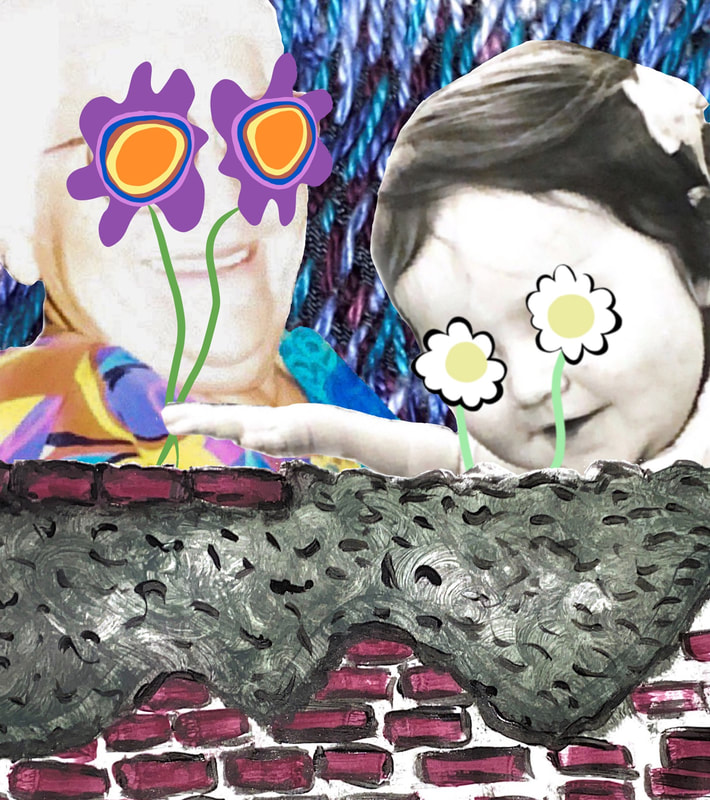
In my grandmother’s garden, I seek communion with a little girl I no longer know. My grandmother watches with milky eyes, always asking (never remembering the answer, of course.)

I don’t know how to communicate what I am feeling (in English or in Spanish), but I try for her the first time.

¿Como estás?
she asks.
No sé, Nana,
pero estoy intentando,
lo juro.

Quietly.
I try my best to smile.
She frowns in confusion and we are both quiet for a moment. Then:

¿Como estás?
One more time.
Bien, bien, ¿y usted?
Loud enough for her to hear this time.
The grin she is used to comes back—
It almost reaches my eyes.


The questions will keep coming and I will write answers in broken Spanish on a whiteboard I hold up to her from across the room. She cannot hear me speak, so I write and she reads, correcting my grammar when she answers aloud, slowly in simple words.

She is talking to someone else, I know: to the girl I have come here in search of.
I am talking to someone else, too: to the woman who raised me so many years ago, before the edges of her memory started wearing thin.

If she understood the thoughts really running through my head (or if I had the courage to speak them aloud) I wonder, sometimes, what she would make of it all.

I do not know why, but my brain takes me back here each time I falter. Trying to untangle these new knots, I suppose I must look to the furthest end of the thread.

So back to the garden of Eden it is.
(The one that I no longer believe in—that she no longer tends to.)

My grandmother and I watch that young girl skip through the overgrown weeds.

When I stand up to go, my grandmother will continue to stand guard, watching. When she can watch no longer, I fear that the girl will be lost forever.

Artist's Statement: "The poem, "Garden of Eden," is in conversation with the visual piece of the same name (obviously), but both the poem and the visual piece also interact with the Biblical story of the same name as well. There is an attempt to return to innocence that will never be fulfilled. Though there is a certain element of melancholy, there is also the acceptance of the proverbial "fall" and reconciling this as a transition. The image plays off of the stereotypical image of Adam and Eve covering their genitals with fig leaves, instead covering the eyes (sight being true vulnerability) with flowers. I was also quite purposeful in using a lot of strange mediums that weren't necessarily "fine" art to further complicate the piece's relationship to the Bible."
0 Comments


Leave a Reply.

    Picture

    Ekphrasis Online.

    An ongoing project to publish submissions that are most suitable to an online format. ​
    submit
    SUPPORT

    Categories

    All

    RSS Feed